A Simpler Path Through Probate for Small Florida Estates
Key Takeaways: Disposition of personal property without administration is a streamlined Florida procedure letting an interested party ask the clerk of court to release a decedent’s personal property without opening formal probate. Under Fla. Stat. § 735.301, it generally applies when the estate consists only of exempt personal property and nonexempt personal property worth no more than the preferred funeral expenses and reasonable medical and hospital costs of the last 60 days of the last illness. A second pathway under Fla. Stat. § 735.304 may cover intestate estates with up to $10,000 in nonexempt personal property, but generally requires that the decedent died more than a year earlier, no administration be pending in Florida, a diligent creditor search be conducted, and the affidavit be served in the manner of formal notice on heirs who have not joined, known or reasonably ascertainable creditors, and AHCA where the decedent was 55 or older. Real property generally falls outside this process, making summary or formal administration the likely route. Institutions that transfer property under the court’s authorization are generally discharged from liability, while recipients may remain personally liable for a pro rata share of lawful claims up to the date-of-distribution value of what they received. Because eligibility depends on precise valuation of every asset, an accurate inventory and early legal guidance can help prevent a rejected filing.
When a loved one passes away leaving little more than a modest bank account, a final paycheck, or a refund check, opening a full probate case can feel disproportionate. Florida law recognizes this. The disposition of personal property without administration Florida process is a streamlined, informal procedure allowing an interested party to ask the clerk of court to release a decedent’s personal property without opening formal administration. It applies only in narrow circumstances, but for qualifying families in Palm Beach County, it can resolve an estate in a fraction of the time a traditional case would require.
If you are unsure whether your loved one’s estate qualifies, the probate attorneys at Moran Law can review the assets and advise you on the right path forward. Call (561) 779-2029 or contact us now to discuss your situation.
The Statutory Foundation Behind This Small Estate Procedure
Florida Statute § 735.301 supplies the legal basis for this process. Under Fla. Stat. § 735.301(1), no administration is generally required upon an estate leaving only personal property exempt under Fla. Stat. § 732.402, property exempt from creditor claims under the Florida Constitution, and nonexempt personal property whose value does not exceed the sum of preferred funeral expenses and reasonable medical and hospital expenses of the last 60 days of the last illness. That rule is narrower than many families expect.
The procedure sits within Chapter 735, Part II, of the Florida Statutes. This placement matters because Part II establishes disposition without administration as a distinct alternative to formal administration under Chapter 733 and summary administration under Part I of Chapter 735. Readers researching Florida small estate statutes will find the entire part oriented toward personal property, not real estate.
Why Real Estate Generally Falls Outside This Process
This procedure is designed for personal property, not land. Estates that include Florida real property generally require a different route, such as summary or formal administration. Families who discover a home, condo, or vacant lot in the decedent’s name should expect a more involved proceeding, subject to exceptions depending on how title was held and whether the property passed outside the probate estate.
How Disposition of Personal Property Without Administration Florida Actually Works
The process generally begins informally rather than with a formal petition. Under Fla. Stat. § 735.301(2), upon informal application by affidavit, letter, or otherwise by any interested party, and if the court is satisfied subsection (1) applies, the court may authorize payment, transfer, or disposition of the decedent’s personal property to those entitled. Authorization comes by letter or writing under the court’s seal rather than through letters of administration.
Any interested party may initiate the request. This is a meaningful departure from formal probate, where a personal representative must generally be appointed before assets can be marshaled. A surviving spouse, adult child, or another person with a legitimate interest may generally make the informal application, though qualifying as an interested party is fact-dependent.
What the Filing Typically Must Contain
Florida Probate Rule 5.420 governs the substance of the request, requiring a description and value of the decedent’s assets and a statement of funeral and last-illness medical expenses to be paid. Petitioners generally prepare this filing using clerk-supplied forms, since statewide requirements are uniform, though local clerks may differ in supporting documentation requested.
Practically, a well-prepared submission usually includes:
- A certified copy of the death certificate
- An itemized list of the decedent’s nonexempt personal property with values as of the date of death
- Paid or unpaid invoices for preferred funeral expenses
- Bills for medical and hospital expenses from the last 60 days of the last illness
- Documentation of the applicant’s relationship to the decedent
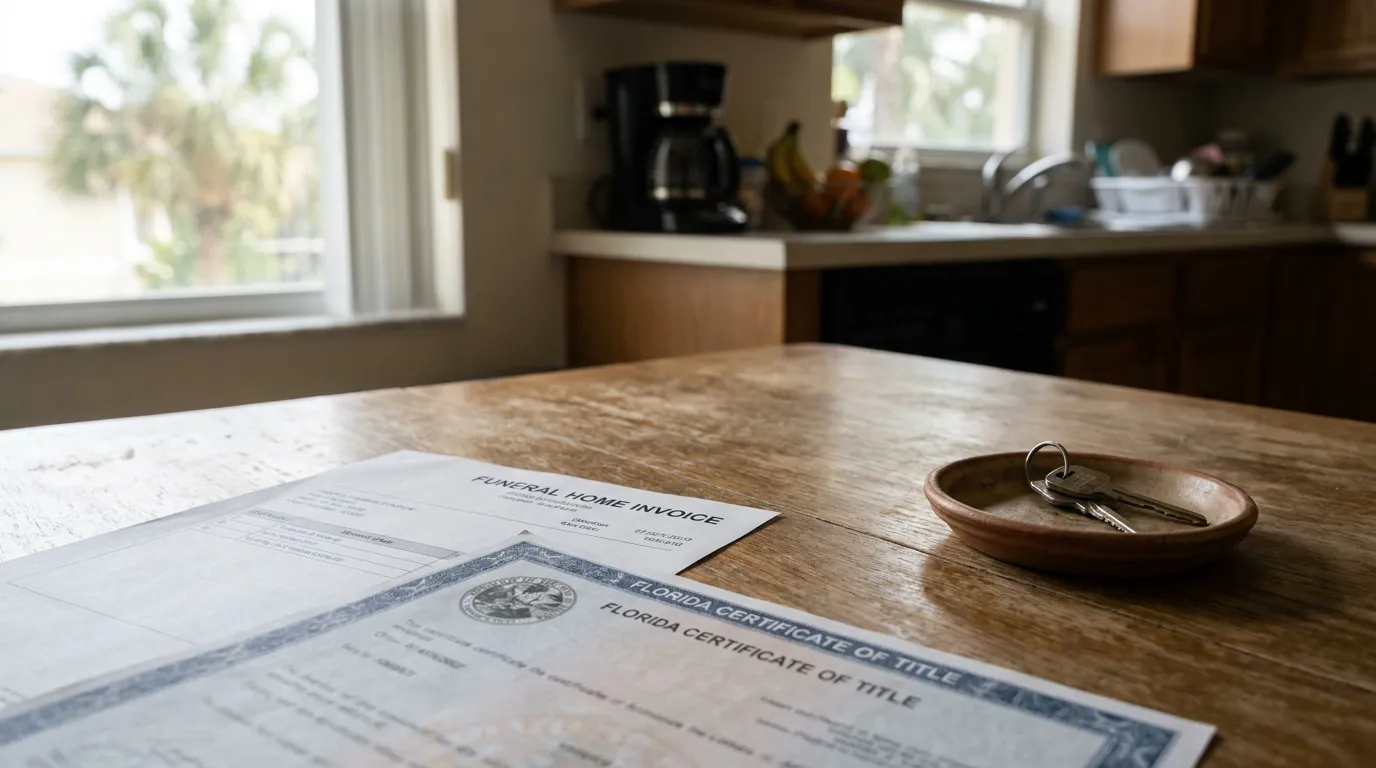
💡 Pro Tip: Gather the funeral invoice before contacting the clerk. Because eligibility under Fla. Stat. § 735.301(1) is measured against preferred funeral expenses and last-illness medical costs, that document often determines whether the estate qualifies at all.
The Alternative Route for Intestate Estates Under Section 735.304
Florida provides a second pathway when the decedent died without a will. Under Fla. Stat. § 735.304(1), no administration is generally required upon the estate of a decedent who died intestate leaving only exempt personal property, constitutionally exempt property, and nonexempt personal property not exceeding $10,000 plus preferred funeral expenses and last-illness medical expenses of the last 60 days. Two additional conditions apply: the decedent must have been deceased more than one year, and no administration may be pending in Florida.
This intestate pathway is generally more procedurally involved. Fla. Stat. § 735.304(2) permits an heir at law entitled to a share under Fla. Stat. § 732.102 or § 732.103 to request distribution by affidavit, signed and verified by the surviving spouse, if any, and heirs at law, with an exception for an heir receiving a full intestate share. Before filing, the affiant is expected to conduct a diligent search for known or reasonably ascertainable creditors, and the proposed distribution should provide for payment of those creditors or their consent.
Comparing the Two Statutory Pathways
| Feature | Fla. Stat. § 735.301 | Fla. Stat. § 735.304 |
|---|---|---|
| Applies to | Testate or intestate estates | Intestate estates only |
| Asset ceiling | Funeral plus last 60 days’ medical expenses | $10,000 plus those same expenses |
| Waiting period | None stated in the statute | More than one year after death, with no Florida administration pending |
| Filing vehicle | Informal affidavit, letter, or otherwise | Sworn, verified affidavit |
| Creditor diligence | Not expressly required | Diligent search and reasonable inquiry required |
| Notice obligations | Not expressly required | Formal notice to non-joining heirs, known/ascertainable creditors, and AHCA if decedent was 55+ |
Notice requirements under the intestate route generally extend to heirs who have not joined, known or reasonably ascertainable creditors, and, if the decedent was 55 or older, the Agency for Health Care Administration, which administers Florida’s Medicaid estate recovery program. That requirement catches many families by surprise and is one reason legal guidance can be valuable before filing.
Liability, Discharge, and the Protections the Statute Creates
The statute protects institutions that release property under a court authorization. Any person, firm, or corporation paying, delivering, or transferring property under the authorization is generally discharged from liability, and bona fide purchasers for value from a recipient generally take free of creditor and heir claims. This is why a bank, employer, or other custodian will typically honor a court letter issued under Chapter 735, Part II without demanding letters of administration, although a custodian is not compelled to act before such authorization is issued.
Recipients, however, may not walk away free of obligation. Recipients under Fla. Stat. § 735.304 may be personally liable for a pro rata share of lawful claims against the estate, but generally only to the extent of the value on the date of distribution of the property actually received, exclusive of exempt property. Separately, under Fla. Stat. § 733.710, and subject to that section’s exceptions, after two years from the decedent’s death neither the estate nor those to whom it was distributed generally remains liable for a claim unless enforcement proceedings began within that period.
Courts generally apply this limitation as a jurisdictional bar rather than an ordinary statute of limitations. Even so, the two-year cutoff is subject to statutory exceptions, and whether a creditor has taken timely enforcement action is fact-specific. Anyone receiving assets through this process should understand that accepting distribution may carry corresponding exposure.
💡 Pro Tip: Keep a written record of every asset received and its date-of-distribution value. Because recipient liability is generally capped at what was actually received, contemporaneous documentation can be meaningful if a creditor later asserts a claim.
When a Different Florida Probate Alternative May Fit Better
Many estates that fail the disposition test may still qualify for a simplified proceeding. If nonexempt personal property exceeds the statutory threshold, or the estate includes real property, summary administration is frequently the next option, generally where the nonexempt estate does not exceed $150,000 (for deaths on or after July 1, 2026; $75,000 for earlier deaths) or the decedent has been dead more than two years. Understanding summary administration in Florida helps clarify which Florida probate alternatives may realistically apply.
Formal administration is generally the default for larger or contested estates. Where creditor claims are substantial, beneficiaries disagree, or a personal representative’s authority is genuinely needed, Chapter 733 administration may be appropriate. Choosing the wrong path can waste months, so an early assessment of the asset schedule generally saves time.
Common Challenges Palm Beach Families Encounter
One of the most frequent obstacles is a misvalued asset schedule. Applicants sometimes overlook a final paycheck, an uncashed refund, or a small brokerage account, potentially pushing the estate past the statutory ceiling after filing. Others discover a supposedly exempt item may not qualify under Fla. Stat. § 732.402, which reaches only specified categories such as certain household furnishings, two motor vehicles meeting the statute’s criteria, qualified tuition programs, and certain teacher and school administrator death benefits. Because eligibility depends on precise valuation, working with a palm beach probate attorney before submitting anything to the clerk can help prevent a rejected filing and the delay that follows.
Frequently Asked Questions
1. Do I need to be a personal representative to use this process?
Generally, no. Fla. Stat. § 735.301(2) permits informal application by any interested party, one of the defining features of this no administration probate route. Whether you qualify depends on your relationship to the decedent and the assets at issue.
2. Does this small estate Florida process cover the decedent’s house?
Generally, no. Chapter 735, Part II addresses disposition of personal property, so estates containing Florida real property typically require summary or formal administration, subject to how title was held and whether homestead protections apply.
3. How long does informal probate in Florida take?
Timing varies by clerk and by the completeness of the filing. Because no personal representative is appointed and no formal case is opened, this process is generally faster than administration, though the court may request additional documentation. The intestate route under Fla. Stat. § 735.304 typically takes longer due to its notice and creditor-inquiry requirements.
4. What happens if a creditor appears after property is distributed?
Recipients may remain personally liable for a pro rata share of lawful claims, generally limited to the date-of-distribution value of what they received. Under Fla. Stat. § 733.710, and subject to that section’s exceptions, this exposure generally ends two years after death unless enforcement proceedings were commenced within that time.
5. Can I file if my parent died more than a year ago without a will?
Possibly. Fla. Stat. § 735.304 was written for that scenario, provided nonexempt personal property does not exceed $10,000 plus qualifying funeral and last-illness medical expenses, no administration is pending in Florida, and the affidavit, notice, and creditor-inquiry requirements are satisfied.
Bringing Clarity to a Difficult Moment
Florida’s disposition of personal property without administration Florida procedure exists to spare grieving families an unnecessary court process when the estate is genuinely small. The eligibility rules under Fla. Stat. §§ 735.301 and 735.304, together with the procedural requirements in the Florida Probate Rules, are precise, the recipient liability provisions can carry real consequences, and the intestate pathway adds notice and diligence obligations that are easy to miss. Every estate turns on its own facts, and an accurate inventory is the starting point for any reliable assessment.
The team at Moran Law helps Palm Beach County families evaluate whether a small estate may qualify for disposition without administration and guides them through the filing when it does. Call (561) 779-2029 or schedule a consultation to get answers about your loved one’s estate today.
Disclaimer: This content is for informational purposes only and is not legal advice. Every case is unique, and results may vary. Consult an attorney about your specific circumstances.